Excavations at the church of Wolder: further research needed to identify skeleton
The remarkable discovery of a skeleton in the church in Wolder, which may be that of the famous musketeer d’Artagnan, has led to extensive scientific research and attracted considerable international interest. The initial findings provide both indications and new questions. For now, the true origin of the skeleton and the circumstances of death remain unclear. Further research may show whether a genuine piece of history has been uncovered – or not.
Friday 13 March 2026
On Friday 13 March 2026, a skeleton found in the church in Wolder was archaeologically documented and lifted during an emergency excavation by physical anthropologists from Saxion University of Applied Sciences and archaeological research agency BAAC, so that it could be examined further. The grave context was also documented by archaeologists. Later that same evening, some of the bones were scanned in the CT scanner at Maastricht UMC+ for further research.
The human remains attracted worldwide attention because they were soon linked to the death of the musketeer Charles de Batz de Castelmore, better known as d’Artagnan, during the siege of Maastricht in 1673. The excavation work carried out before 13 March was not documented according to standard archaeological procedures. As a result, a significant amount of archaeological information has been irreversibly lost.
The siege of Maastricht in 1673
In recent months, the skeleton has been the subject of archaeological research, partly prompted by the possibility that it could be the skeleton of d’Artagnan. In romanticised form, d’Artagnan became world-famous through Alexandre Dumas’ 19th-century novel Les Trois Mousquetaires. The historical d’Artagnan was a musketeer in the army of the French king Louis XIV and served as the king’s personal bodyguard. He already had an impressive record of service when, at the age of 62, he went into battle during the siege of Maastricht in 1673. On 25 June that year, d’Artagnan was killed during the assault on the Tongersepoort. On the same day, 80 musketeers and around 100 guardsmen were killed, while around 50 officers and 500 other soldiers were killed or wounded. Those who died had to be buried quickly to prevent disease in the French encampments. Mass graves had already been dug for this purpose. According to historical sources, little distinction was usually made between ordinary soldiers and senior officers when their remains were buried, and most were left in mass graves. Only certain members of the nobility were buried in consecrated ground, meaning in a church or churchyard. The first question, therefore, is whether d’Artagnan belonged to this latter group, or whether he too ended up in a mass grave. We do not know the answer. However, if he was buried in consecrated ground, in other words in a church or churchyard, several churches near Maastricht could be considered: the churches or churchyards of Eben (BE), Emael (BE), Kanne (BE), Montenaken (BE), Slavante (NL), Riemst (BE), Kesselt (BE) and Wolder (NL). Historical sources also show that some French generals were even taken to the hospital in Tongeren (BE), where they often died and were subsequently buried in mass graves.
In 1962, the French historian Charles Samaran wrote an article titled ‘Le siège de maestricht et la mort de d’Artagnan’. On the final page, he writes, in translation: “Where was the famous musketeer, whose name Dumas would make known throughout the world, buried? Probably at the very place where he died, like so many soldiers left on the battlefield; but to our knowledge, this is not mentioned in any document.” The claim made in 2005 by the French historian Odile Bordaz that d’Artagnan must be buried in the church in Wolder because Louis XIV’s royal tent stood there and because d’Artagnan must have been buried in consecrated ground is only an assumption, for which there is no evidence. The other churches and churchyards mentioned above could also have been d’Artagnan’s final resting place, and the many mass graves cannot be ruled out either.
Historical context of the place of discovery
The remains are said to have been found in the church in Wolder at the site of the former altar of the old church. Archaeological research has shown that the structure was probably not the foundation of an altar, but more likely the foundation of the steps leading up to a raised choir.
The death register of the church in Wolder shows that during the siege by Frederick Henry in 1632, 41 years before Louis XIV’s siege, around 255 people were buried in and around the church in Wolder. They came from France, England, Germany, Flanders, Wallonia, Holland, Scotland and Poland. Most of the officers were noblemen, and most of them came from France. The register even mentions a nobleman from Gascony, the region where d’Artagnan was born, although he was killed 41 years before d’Artagnan. Where the register mentions the location of a grave inside the church, this could be anywhere in the old church; there was therefore no preferred location. Consecrated ground includes both the church itself and the churchyard. The claim that the location where the grave was found was reserved for someone of d’Artagnan’s status is therefore merely an assumption.
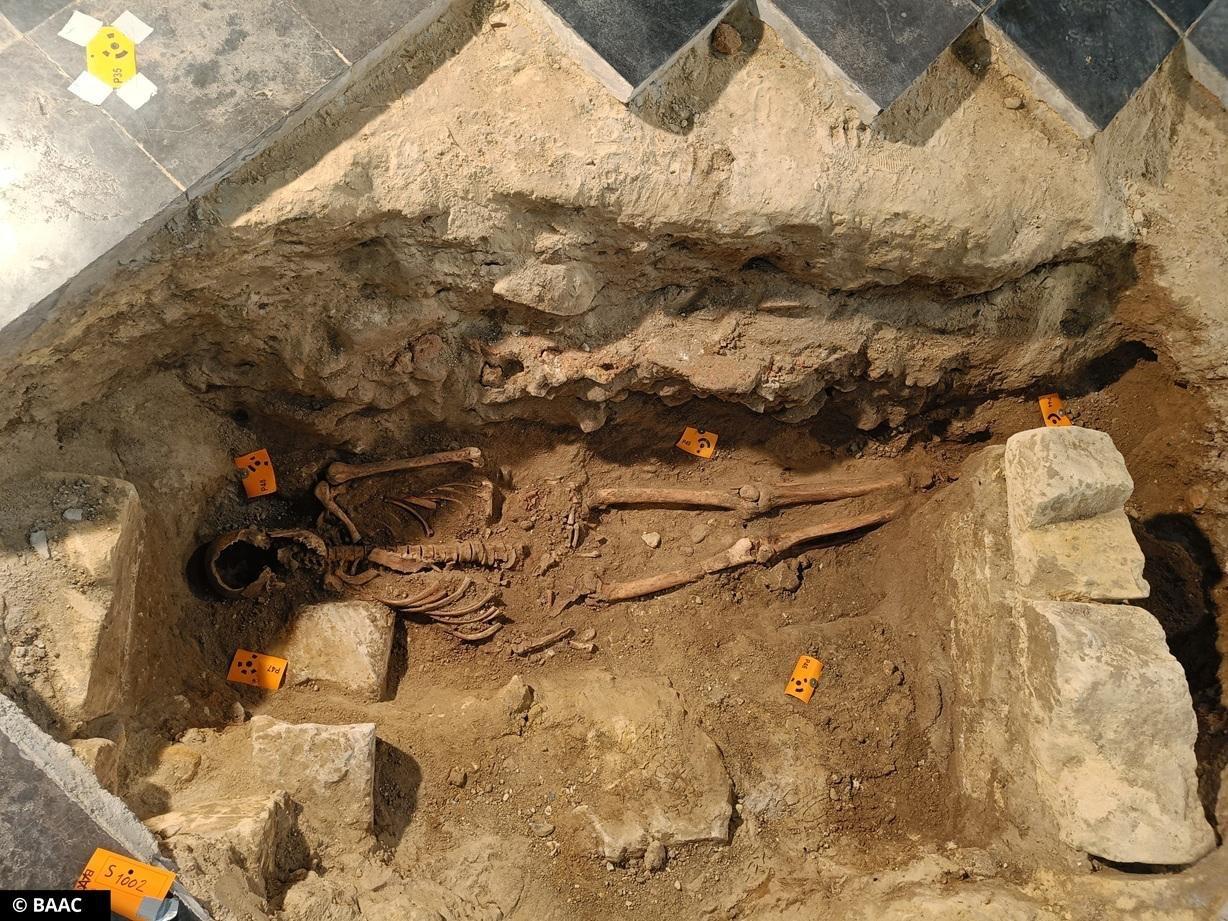
When the grave was created, a medieval floor was cut away. It was established that the body in the grave had not been buried in a coffin. The body was probably placed in the grave pit wrapped in a shroud. The grave was bordered on 3 sides by remains of marlstone foundations. The stones were partially worked to allow the grave to be dug. It appears that the body was placed between the marl stones with some difficulty; the skeleton was not lying completely flat. Due to the way in which the excavation work, which predates 13 March, was carried out, it is no longer possible to draw any conclusions about the grave pit or the level from which it was excavated. Stratigraphically , it is therefore no longer possible to date this grave.
A complex puzzle of bone remains: initial indications, but still many uncertainties
The skeletal remains were examined further at Saxion University of Applied Sciences in Deventer (NL) by 2 physical anthropologists, from Saxion and BAAC respectively.
At the time of the emergency excavation on 13 March, around 50% of the original skeleton was still in its original position. The situation is highly complex because, during the initial excavation work, various bones were collected without documentation. It is unclear whether these bones belong to the skeleton that was found or to another individual. The reconstruction process showed that bone remains from 2 young individuals were also present, as well as several adult bones that are not part of the skeleton.
Around 1/3rd of the skull of the skeleton itself is missing. This concerns the right side. Photographs show that the hole in the skull became progressively larger as the excavation work prograssed, indicating that the damage is recent. Around 1/3rd of both the lower and upper jaw is also missing. Based on the research and the CT scans, the following conclusions can currently be drawn.
- The skeleton is that of a man approximately 1.74 metres tall.
- The estimated age at death is between 44 and 66. These results could fit d’Artagnan’s age at death, which was 62.
- During the initial excavation work, before 13 March, an object was found and interpreted by the excavators as a bullet. Mass spectrometry has shown that the object is made of iron and has a clean weight of 3.3 grams. A lead bullet would weigh 16 to 19 grams in the case of a pistol bullet, and 38 to 41 grams in the case of a musket bullet. The object that was found is now interpreted as part of a forged nail.
- An attempt was made to date the skeleton by obtaining a C14 date, or radiocarbon date, from a rib and a toe phalanx. However, the calibrated results of the analysis did not produce a clear date: the range extends from 1500 to 1900 AD. More precise dating based on C14 is therefore not possible.
- Analysis of the collagen in the samples showed that this person consumed a considerable amount of marine fish: fish accounted for between 27 and 30% of his regular diet. This is an exceptionally high proportion and does not match what would be expected for someone from Gascony who also spent much of his life in Paris and Lille. It could only be explained if this person regularly ate fish from the sea. Although sea fish was sold at markets in Paris and Lille in the 17th century, and salted fish was also eaten inland, it remains unclear whether musketeers would have been served this kind of food frequently. This raises the question of whether such a diet was common among Catholic musketeers from France in the 17th century.
- The isotope research has produced results for strontium, oxygen and carbon. Tooth enamel was sampled from the molars (M1, M2 and M3). The results show a similar picture to the samples used for C14 dating: either this person consumed relatively large amounts of fish in his early years, or he had a diet relatively rich in so-called C4 foods, such as millet and sugar cane. According to the available reference tables, the values found would point more towards Eastern and Southern European diets.
Indications and uncertainty: research so far does not rule out identification as d’Artagnan
Based on the scientific findings to date, it is not possible to rule out entirely that the skeleton found is that of d’Artagnan.
The results of the investigations carried out so far show several surprising elements. In terms of physical anthropology, the age category and sex of the skeleton found fit the profile of d’Artagnan. The isotope analysis presents a different picture. Gascony cannot be confirmed as the region of origin, and the findings point rather towards eastern or south-eastern Europe. Such values can only be explained if this musketeer had a very fish-rich diet during his life. Unfortunately, it is not known what a musketeer’s regular diet would have been in the 17th century. At present, the research results do not confirm an origin in Gascony. Based on the current data, this makes identification as d’Artagnan less likely, although it cannot be ruled out.
Further research needed, including ancient DNA analysis
The proposal is to have additional research carried out to determine whether identification as d’Artagnan is possible.
A key part of the follow-up research will be the analysis of ancient DNA. This will involve taking a small sample from the root of a molar. Based on the full genome, comparison with population genetic data may make it possible to establish a possible region of origin. If the resulting profile also points, for example, to eastern Europe, identification as d’Artagnan would be very unlikely. If, however, this research cannot rule out identification as d’Artagnan entirely, further research will be carried out. That analysis would focus on both the direct maternal line and the direct paternal line, using mitochondrial DNA and the Y chromosome respectively. Specific descendants of d’Artagnan would then need to be approached to provide DNA. From the actual start of the research, the full aDNA study is expected to take approximately 6 months.
Even after the follow-up research has been completed, a definitive identification may still not be possible.